Certificate Authority Scoping for CBA Lands in Microsoft Entra
In PKI-heavy environments, broad certificate trust gets messy fast. If every trusted certificate authority is valid for every user, you lose the ability to say “these certificates are for these people.” Certificate Authority Scoping for CBA gives Microsoft Entra admins that missing boundary, and it’s the control a lot of teams have wanted for a while.
What the feature does
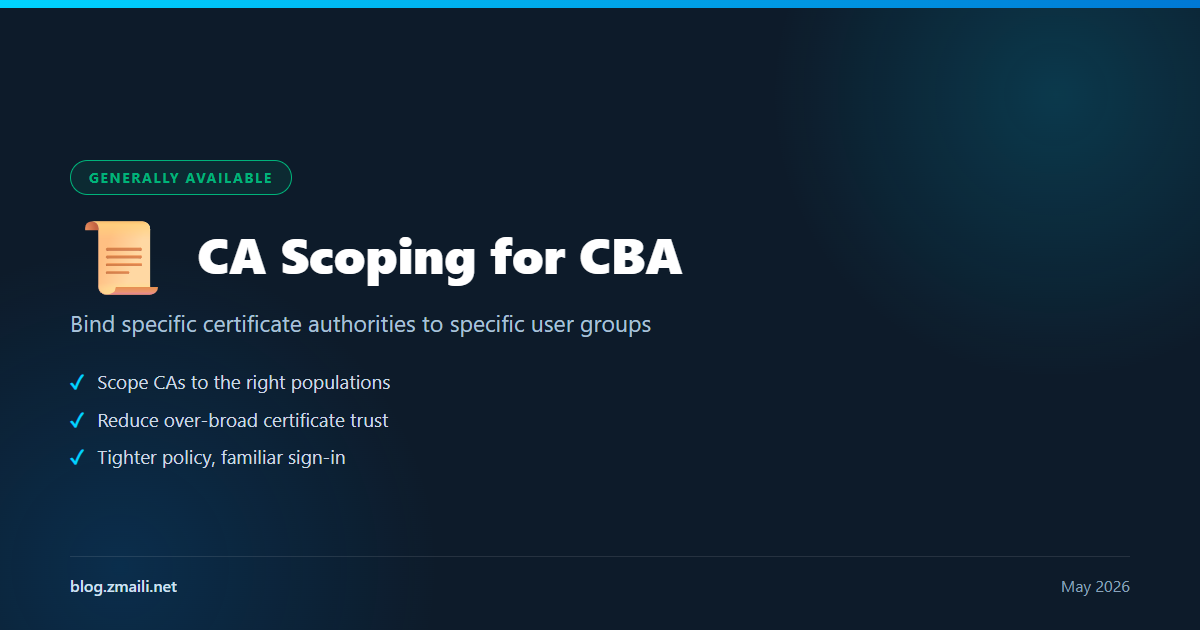
Certificate authority (CA) scoping lets you bind specific certificate authorities to specific user groups for certificate-based authentication (CBA). Instead of trusting every CA tenant-wide, you define which issuing CA is valid for which Microsoft Entra group.
The result is a precise enforcement layer. A user authenticates only with a certificate issued by the CA that’s actually intended for their population — and a certificate from a different trusted CA won’t satisfy the sign-in for users it wasn’t meant for.
Why it matters
- Matches real organizational structure — contractors, privileged admins, subsidiaries, B2B users, and separate regional PKIs each get the CA that belongs to them.
- Reduces over-broad trust so a certificate from one population can’t be used by another.
- Tightens policy without changing the user experience — the sign-in flow stays familiar while the authentication boundary gets more exact.
How to enable it
- Go to Entra ID > Authentication methods > Certificate-based authentication.
- Open the Certificate issuer scoping policy and add a rule.
- Filter CAs by PKI, select the issuing CA, and map it to the appropriate Microsoft Entra group.
- Save the rule, confirm sign-in success in the logs, and repeat for your other scoped populations.
Where it fits
Zero Trust is about least privilege expressed everywhere, including in how certificates are trusted. CA scoping turns a flat trust model into a segmented one, so the authentication boundary reflects who a user actually is and which PKI issued their credential. For organizations consolidating multiple PKIs or onboarding partners, this is the kind of control that keeps trust from sprawling.
Conclusion
This feature tightens policy precisely where PKI-heavy environments tend to lose control, without forcing a new workflow on users. If you manage more than one CA or more than one user population, CA scoping is a clean way to make certificate trust intentional.